Delicate Art of Fruitful Consumption.
Consumption and creation are in tension but not opposition. Inspiration, for example, is often found in the course of consumption. The real split is between fruitful versus barren consumption.
The “consoom” meme ridicules those who supposedly spend their lives stupefied by low-value consumption. It has some hilarious renditions, but ultimately it’s mean-spirited, and one has to work a little hard not to let that eclipse the insight it carries. Mindless entertainment, especially in its perfected form of infinite scroll interfaces, is simply not conducive to human flourishing. Study after study returns an unfavorable verdict.
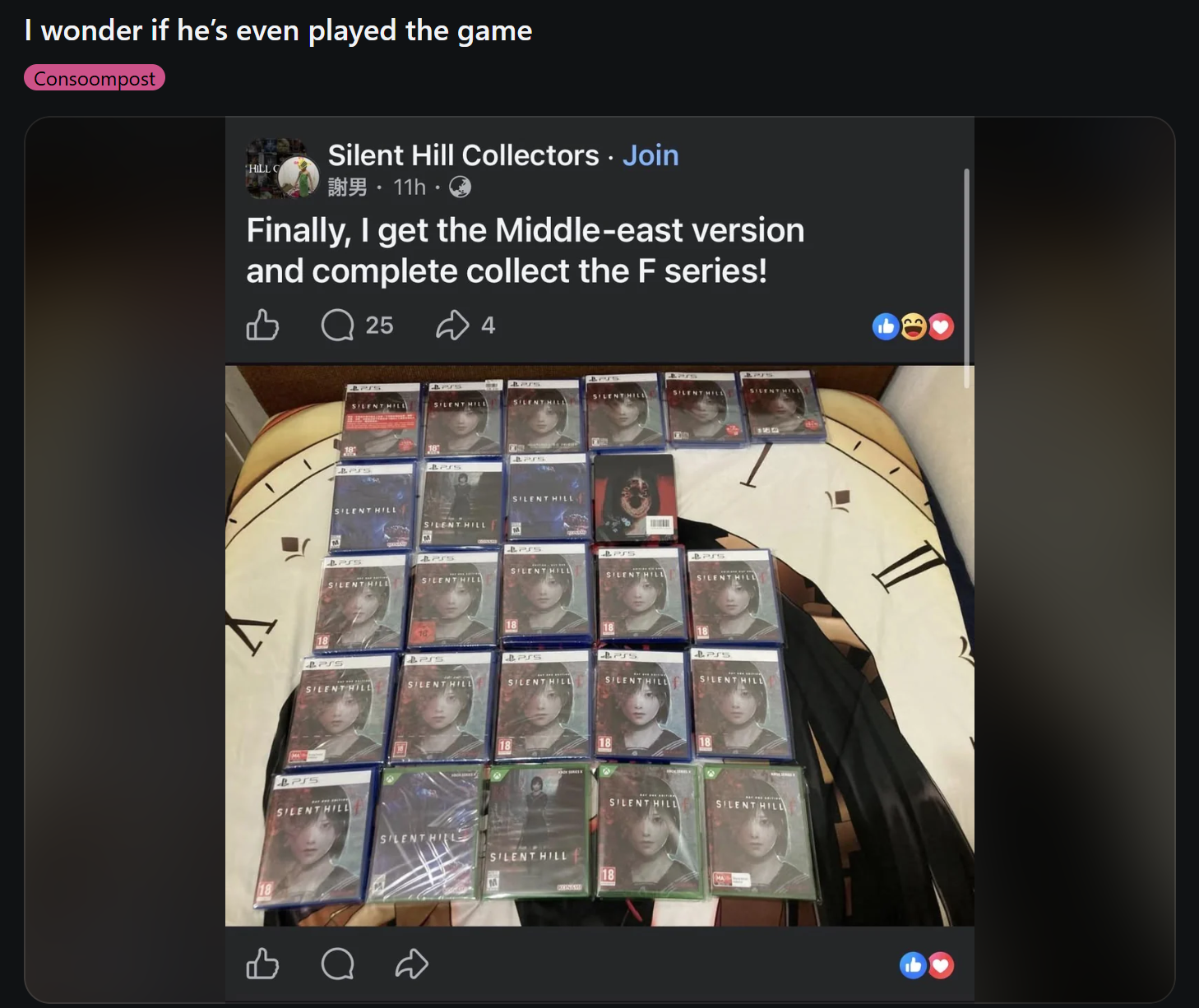
The meme’s net is much wider, though, and it’s arguably more about geek culture. Common targets of mockery are video games, Marvel Universe characters, and collectibles the likes of Funko Pops. Fundamentally, the ridicule is less about accumulation itself but accumulation channeled fruitlessly. Another objection against this particular consumerist culture, which I find valid and a little pathetic, is that the object is a vehicle for sedation rather than self-transcendence. The enjoyer resembles a narcotics addict rather than a connoisseur.
 tawanda.space/blog
Regardless, accumulation itself simply cannot be the problem.
Is accumulation not a somewhat inescapable drive? Even the solitary monk is trying to gather spiritual insight. The religious zealot seeks to pile up good deeds. Amish folk aggressively hoard predictability in a world that sheds its skin at a dizzying pace. And so forth. Everyone, in their own way, is looking to maximize satisfaction. One can note, without taking sides on the issue, that the quality of human life is measured in surplus.
So if consumption produces surplus, is it not good?
That question, in its rhetorical and live cultural form, is an expression of the human moral instinct, which expresses itself in the identification of poles. In this case, consumption vs. creation.
The two are in tension but not opposition. Inspiration, for example, is often found in the course of consumption. The real split is between fruitful versus barren consumption.
Four Measures of Fruitful Consumption
You’ll find that there’s no productivity angle here, no claim that consumption is only good if it has a utilitarian output. The distinction is more along the lines of healthy vs. unhealthy uselessness. It’s worth acknowledging though that healthy uselessness tends to be potentially useful, should one so wish to convert it.
1. What it asks of you (Co-creation)
Although I was years from coming into the world, I have an abiding adoration for early to mid 90s gaming. Pixel art had reached a stunning peak. The soundtracks had leapt from beeps and boops to cinematic scores that rivalled film.
I’ve enjoyed a few Boss Fight Books entries on the history, inspirations, and deeper messages of these games.
When I boot up an emulator to play SNES game on my phone, I’m asked to bring more than mindless escapism. The game rewards a discerning ear, a third and a fourth read of its pixel art, and emotional investment in the 16-bit sprite characters.
The art form has more than enough substance to reward an obsessive bent.
Good consumption asks you to be a co-creator. You bring sustained attention, an interpretation, and multiple guesses for how the story might develop.
2. Fundamental honesty (Contract)
I don’t seek depth in all my pastimes. I don’t believe that’s healthy. My stance is that having one or two low-fidelity consumption preferences is perfectly normal and should be encouraged. I’ll explore this further in the coming Consumption Diet section.
Mine is these Lifetime movies where the actors are not trying to be Oscar winners and the stories make no attempt at nuance. The productions are admirably transparent and their contract with the viewer is never in doubt.
Another example is wallpaper, those tunes you put on precisely because they blend into the air. The form delivers what it promises.
A slight wrinkle is that some art forms, approached with the right hunger, deliver more than they advertise. What keeps them in the fold of honesty is that this always feels like they’ve held back a pleasant surprise.
3. Some activation energy (Desirable friction)
The activity must offer a degree of resistance when you first start it. That’s often sustained attention, having to remember where you left off, choosing which genre or edition to engage with, et cetera.
The consumption activities that are unhealthy try to remove all barriers. If you open Readly, for example, you are faced with a magazine rack. Before you can reach a state of flow, you have to (i) choose a publication, (ii) choose an issue, (iii) decide whether to read from the first page or riffle through it until you find a story that interests you.
4. Positive residue (Accumulation)
Your 500th TikTok is not more pleasing than the first. In fact, it’s likely less so. Also, after finishing a TikTok, the most you can do is leave a comment, though you’re often more likely to flick your thumb upward.
Say you read a novel, though, even a supposedly trashy one, like a Sidney Sheldon. The positive residue, the surplus, is that you can extend the experience beyond the form. You can critique, chew over the plot and characters, leave a review on Goodreads that itself attracts comments, see if there’s a movie adaptation, or write fan fiction.
And your fifteenth novel is often a richer experience than your first. The context of each earlier entry makes you better at appreciating the next.
Of those four, I consider co-creation the most central. It’s a reliable predictor of the other three.
The Diet
The need for a consumption diet is to avoid parasitic and invasive pastimes. For example, because doomscrolling and outrage-seeking are so potent and within quick reach, they can become the default whenever there are five minutes to kill. Worse, more insidiously, they obliterate one’s capacity for more fulfilling activities.
The trick is to have multiple pastimes that contain different amounts of those four criteria, so when one is unsuitable because of mood or exhaustion, at least one other is available. Without this, the risk is that when a fulfilling but slightly demanding activity feels out-of-reach, one will reach for the many seductive, zero-energy activities now available.
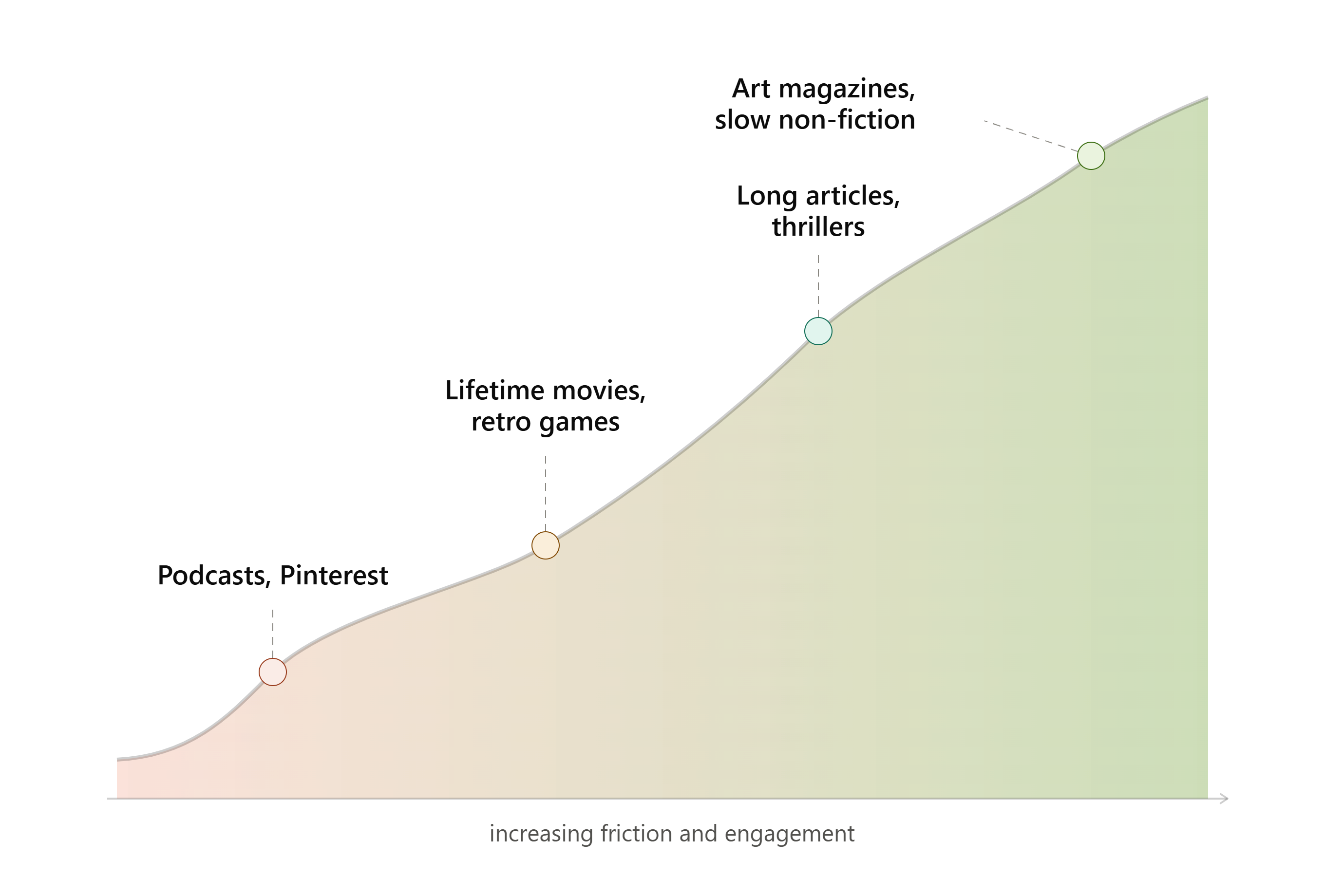
I split consumption by energy level (within the context of leisure) into 5 stages from very low to high. The reason “very high” doesn’t feature into the matrix because, ideally, it should coincide with creation rather than consumption.
In my case, it looks like this:
 tawanda.space/blog
Very high would be veering into writing fiction, making music, or producing an essay like this one.
The most dangerous stage is when energy is low. That’s when it’s easiest to reach frictionless activities, mostly delivered via smartphone, and they won’t take long to displace everything higher up the slope.
Wayside Thoughts
These are a few things that crossed as I was writing that feel worth adding.
Deeper axes of quality
I have intentionally tried to strip class-coding from consumption activities. Something can fail on one axis and score highly on seemingly contradictory ones.
For example, genre fiction is typically class-coded as “trashy.” Much of it is, but so is much of literary fiction. But consider a good Sidney Sheldon novel. The prose is nearly invisible, and that is an art. The emotional manipulation is blatant, and that is by consent and it’s done masterfully.
If there’s a connection between the fruitfulness of an activity and its prestige, it’s not always reliable.
Appeal of earlier eras
Aggressive monetization and dodgy engagement mechanics have infused a neurotic air into today’s media.
The ones that are still intact are digitizations of legacy media. My most cherished example is Readly, which gives you issues of magazines as they would appear if you’d bought physical copies. Among the digital-native options, only a tiny few are respectful of the reader’s attention. Atavist magazine is my best pick.
Another problem is that today’s media has been blunted by over-sensitivity. Richard Herley, an author I greatly like, observed this sourly when he said his work, which I certify as having much artistic merit, would not survive contact with a sensitivity reader.
Archive.org’s magazine section is a fine repository for anyone who wants to keep their own sensibilities sharp.